The Altar That Music Built:
Basque Youth, Secularization, and the Search for the Sacred
From the gaztetxe to the digital pew — how a generation rebuilt its spiritual life outside the Church
I. The Collapse of Institutional Faith
The Basque Country presents one of the most striking cases of rapid religious secularization in Western Europe. A region that was, within living memory, among the most devout Catholic communities on the continent has seen its institutional religious life effectively dissolve within a single generation.
Basque Religious Identity — Key Figures
Among Basque youths aged 15–29, only 34% identify as Catholic and just 4% as practicing Catholics, according to the Basque Youth Observatory.1 This represents a profound rupture from the region’s historical character. Basques were known from the 1600s through the 1970s for devout Catholicism with an especially strong devotion to Mary, yet church attendance has since dropped by more than 80%.2
The transformation was not gradual but accelerated dramatically after the end of Francoism. The Spanish Basque Country experienced a quick and radical process of secularization following the dictatorship, with the Basque political and cultural movement distancing itself from the Church and from any religious reference.3 What had been an alliance between Basque identity and Catholicism — forged partly in opposition to the Francoist state — dissolved as the political context shifted.
Crucially, this disengagement is now being reproduced institutionally. Enrollment in religious education has been steadily decreasing in the Basque Country, where secular and pluralistic educational models are more prevalent than elsewhere in Spain. These educational policies contribute substantially to shaping young people’s religious disengagement and the rise of individualized spirituality.4
II. The Spiritual Void and Its Consequences
The decline in institutional religion does not mean the disappearance of the needs religion once served. Researchers and commentators across Spain consistently identify a resulting hunger — for meaning, community, identity, and ritual — that has not been extinguished but redirected.
As secularization progresses, the decline of religion leads to existential questions and a search for alternative sources of meaning and belonging, as well as a decline in communal bonds that requires new forms of community-building.5
Spanish sociologists make an important distinction here between religion and spirituality. The term “religion” applies to more institutionalized manifestations, whereas “spirituality” refers to more subjective manifestations with vaguer structures and little institutionalization — and this distinction is most common among young people.6 Young Basques are not, in this reading, spiritually empty. They are spiritually unhoused.
“Faith in God is resurgent in the West, much more so among young people than in other generations, because it offers a moral example, but also a lifeline to hold on to; the neoliberal project is falling apart, leaving corpses in its wake.”
This framing positions spiritual seeking not as a regression but as a rational response to systemic failure — a generation reaching for transcendence precisely because secular ideologies have not delivered coherence.
III. Music as the New Sacred Space
The deep roots of musical spirituality in Basque culture
To understand how music came to carry spiritual weight for Basque youth, it is necessary to understand that it has always done so. Music in the Basque tradition was never mere entertainment. Early Basque music had clear spiritual power and marked major occasions in the lives of individuals and communities.8
During the Franco dictatorship, music became the primary vehicle of cultural survival. Basque folkloric dance performances and the Basque language itself were outlawed for the first twenty-five years of the Franco government, perceived as inflammatory of nationalist sentiments. As the Basque language was maintained primarily through oral transmission, so was traditional Basque music.8
The artistic collective Ez Dok Amairu, active between 1965 and 1972, fused song, poetry, dance, and resistance into a single cultural project. Its leading figures — Mikel Laboa, Benito Lertxundi, Xabier Lete — evoked emotions Basques could relate to: despair, hope, and defiance.9 Their work was not protest music in a narrow political sense. It was a civilization’s attempt to keep itself alive through sound.
The gaztetxe as secular sanctuary
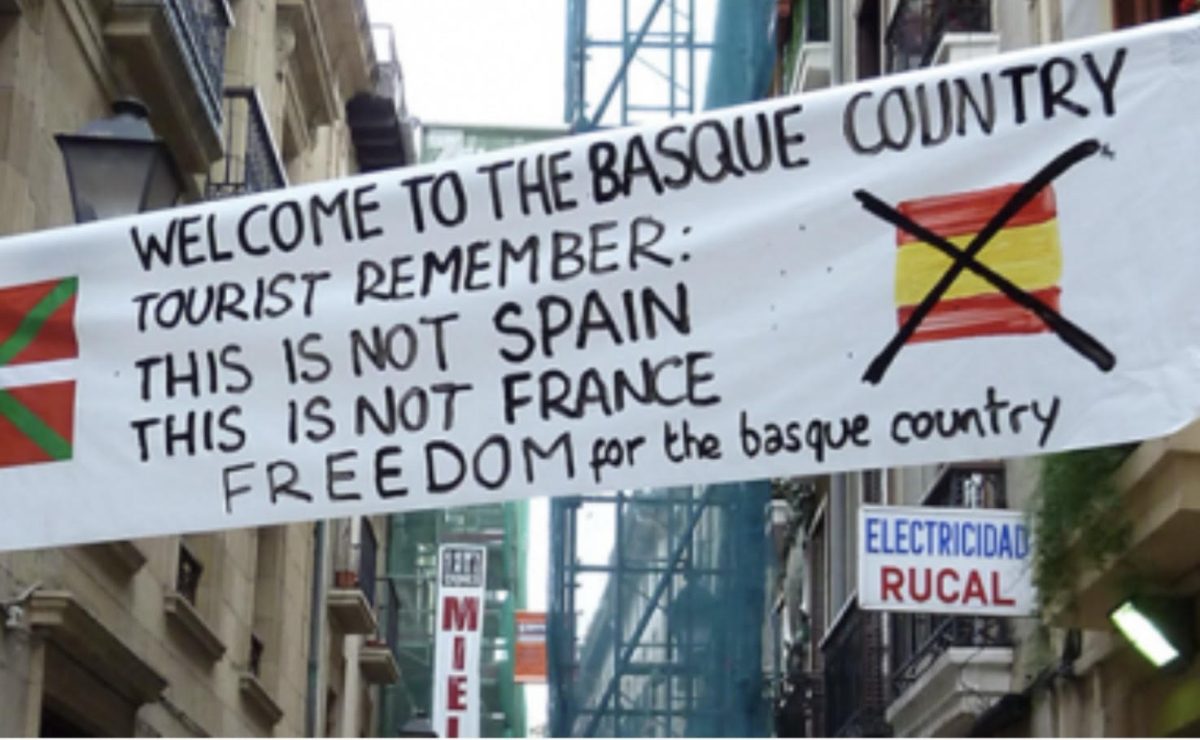
In the post-Franco decades, a new institution emerged that absorbed many of the community functions the Church had previously held. A whole network of youth squats — the gaztetxes — sprang up all over the Basque Country, furnishing young bands with premises to rehearse and a venue to stage concerts. For the first time, a younger, disaffected generation stemming from urban sprawls could find an outlet to voice protest along the lines of a punk “do it yourself” ethos.10
The gaztetxe was explicitly conceived as an autonomous space — not owned by the state, the church, or commercial interests. Self-management was a key postulate of the autonomous movement of Euskal Herria. The gaztetxe was not originally intended as a place for young people, but as an autonomously run place for everybody.11 This is precisely the structural logic of the pre-modern parish: a common space, owned by no faction, that belongs to all.
The tradition persists with vigor today. New groups are constantly being formed, performing at concert halls, cultural centres, gaztetxes, and bars across the Basque Country. Basque folk, pop, and rock music has been used for everything from poetry to social and political change, from entertainment to personal conviction.12
The contemporary underground scene
A new generation of young Basque musicians born in the 1990s — straddling Generation Z and millennials — is rediscovering distorted and melodic sounds of previous decades while incorporating contemporary influences. Like all grassroots movements, it is described as vibrant, genuine, and irresistibly appealing, with Bilbao and Pamplona as its nerve centres.13
What is notable about this scene is its emphasis on community over commerce. One musician describes the role of the gaztetxe network: “The fact that there are so many places to play and you don’t have to pay 500 euros for a venue, as happens in other places, is amazing. There’s a gaztetxe in almost every village.”13 This is not the language of a music industry. It is the language of a commons.
“When a work surpasses the recognition of its author, it becomes part of society. The work shifts from belonging to the author to becoming the property of the audience.”
This is, again, a description of how sacred texts function within a living tradition. The work is no longer the artist’s. It belongs to those who need it.
IV. The Unexpected Return: Catholic Aesthetics Among Gen Z
While the secularization of Basque youth remains structurally entrenched, a broader European and Spanish phenomenon complicates any simple narrative of religious decline: the aesthetic return of Catholic imagery, ritual, and symbolism among Generation Z.
New data from Spain indicate that a significant segment of Spanish youth may be rediscovering religious identity in ways that challenge both sociological assumptions and pastoral expectations.14 The phenomenon has been widely observed in Spanish media. A prominent journalist noted that “a new generation of young people is rediscovering the sacred — faith has become a trend, and also a refuge: young people who find spirituality in films, in Rosalía’s songs, or in digital altars where influencers preach the beauty of believing.”7
Aesthetic engagement without institutional commitment
Critical to understanding this phenomenon is the distinction between aesthetic and doctrinal return. Most Gen Z aesthetic Catholics are not returning to weekly Mass or traditional doctrine. Their engagement with Catholicism’s symbols keeps its cultural presence alive in new, secular forms. For Gen Z, Catholicism is not necessarily a belief system to follow, but a visual and emotional archive to reinterpret — a way to access the sacred amid digital overstimulation and cultural disillusionment.15
The sensory richness of Catholic tradition is central to this appeal. Catholicism’s aesthetic depth — incense, organ pipes, rosaries, the Eucharist — offers something transcendent to a generation raised on curated content. The liturgy and sacraments provide ritual that feels sacred in ways that digitally manufactured atmospheres cannot replicate.16
Young people are rediscovering venerable rites in which gestures are measured like dance steps, and the beauty of liturgical chants that are not a poor imitation of commercial music. Digital natives now feel the need to be analog, to rediscover themselves as part of a network that extends through space and time — not just children of history, but children of the eternal.17
Spanish cinema and the sacred imagination
A new wave of Spanish cinema and digital media is rediscovering the silence, symbolism, and spiritual resilience of religious life. The film Los Domingos, which won the Golden Shell at the San Sebastián Film Festival, tells the story of a teenager drawn to convent life. A popular Spanish podcast, Las Hijas de Felipe, revisits the writings of 16th-century nuns as guides for modern living.18
It is significant that the San Sebastián Film Festival — based in the Basque Country — has been a site for this rediscovery. The sacred imagination is not arriving from outside. It is emerging from within the same cultural landscape.
V. Two Movements, One Hunger
The evidence points toward a paradox: Basque youth are among the most secularized in Spain, yet they inhabit a culture in which music has long carried sacred freight, and they are part of a generation increasingly drawn to the symbolic grammar of the religion they left.
These two movements — the alternative altar of the gaztetxe, and the aesthetic return to Catholic imagery — are not contradictory. They are parallel expressions of the same underlying need: for ritual, beauty, communal belonging, and a structure that can hold the weight of human experience.
Basque dance and music have functioned as tools in the construction of collective identity, moving from ritual contexts to national discourse — a living and plural expression that continues to redefine itself today, becoming a space for reinterpreting identity and community.19
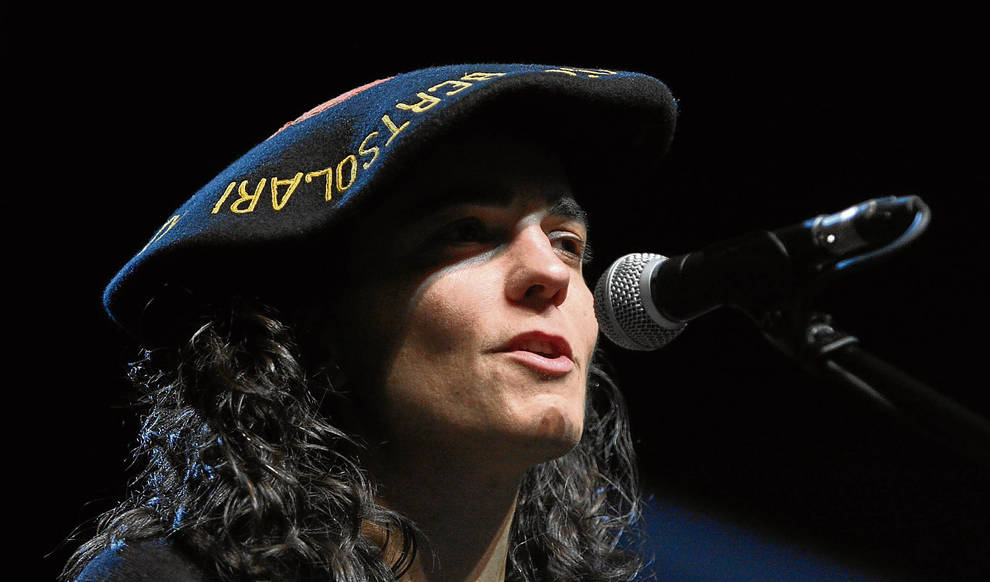
The tradition of bertsolaritza — improvised sung verse performed before live audiences — embodies this most clearly. The bertsolari improvises verses in Basque before an audience, composing immediately on a given theme: wit, emotion, and rhythm with no script or trickery. During the dictatorship it was a refuge and cultural resistance; today it is a symbol of identity and living art, with championships that fill squares and theaters.20
The bertsolari does not resolve the questions of existence. They give them form, rhythm, and shared breath. And a community that can sing its grief together is not the same as a community that has no grief. It is a community that knows what to do with it.
“In a world of chaos and alienation, young people are craving order but also the indulgence of faith Catholicism offers. Not pragmatism, but mysticism.”
For Basque youth, this mysticism does not necessarily require the Church. It lives in the gaztetxe in Bilbao, in the underground venue in Pamplona, in the sung verse improvised on a village square. The altar was not destroyed. It was rebuilt, plank by plank, in every space where something true was performed for those who needed to hear it.
VI. Conclusion
The secularization of Basque youth is real, measurable, and likely irreversible in its institutional dimension. The Catholic Church will not recover the grip it held through the mid-twentieth century. The data from the Basque Youth Observatory make this plain.
What the data cannot measure — but what the cultural evidence strongly suggests — is that the needs once served by the Church have not disappeared. They have migrated. Into music. Into collective performance. Into the shared experience of a generation that has lost the inherited container but not the hunger it held.
The phenomenon of Gen Z’s aesthetic return to Catholic imagery adds a further layer. Young people across Spain are not becoming devout Catholics. But they are reaching back toward Catholic ritual, symbolism, and beauty as resources for spiritual expression — suggesting that the symbolic vocabulary of the Church retains power even after the institution has lost authority.
The figure of the priest of the people, described by one writer in relation to Yung Beef, has a Basque equivalent: the bertsolari, the folk singer-songwriter, the underground band playing a gaztetxe in a village that still has no commercial venue but has always had a hall where people can gather and hear something true spoken aloud.
That, in the end, is what worship has always been.
References & Sources
- Basque Youth Observatory / SUSA Exchange Program data cited in: “From Basque Country to Coronado: an exchange of religion and culture.” The Coronado News, July 2024. thecoronadonews.com
- “Basque Paganism.” North American Basque Organizations. nabasque.eus
- Bourdieu-Sagardoy, et al. “Towards a Disconnected Religion? The Catholic Church and the Secularization of Basque Culture in the French Basque Country.” HAL-SHS Sciences de l’Homme et de la Société, 2016. shs.hal.science
- “The transformation of the relationship between Spanish youth and religion.” Tandfonline / Journal of Contemporary Religion, January 2026. tandfonline.com
- Farhan R. “Evolving Beliefs: The Impact of Secularization on Modern Religious Practice.” Longdom Publishing. longdom.org
- Salguero, quoted in: “Is there a change in the religiousness of young people?” Evangelical Focus. evangelicalfocus.com
- “In Spain, everyone is talking about the renewed interest in the Christian faith.” Evangelical Focus, October 2025. evangelicalfocus.com
- “Basque Music and Dance.” FolkWorks, July 2023. folkworks.org
- Watson, Cameron. “Protest Music and Survival in the Basque Country.” University of Mississippi Honors Thesis, eGrove. egrove.olemiss.edu
- “Basque music.” Wikipedia. en.wikipedia.org
- “The Gaztetxe of Gasteiz, a project cooked over a slow flame.” Hala Bedi / Argia, 2018. halabedi.eus
- “Basque music: pop, rock, folk.” Etxepare Euskal Institutua. etxepare.eus
- “The guitars are back! An X-ray of the new Basque indie scene.” Basqueculture.eus, June 2025. basqueculture.eus
- “A generation returns? New data suggest a surprising revival of Catholic identity among Spanish youth.” ZENIT, April 2026. zenit.org
- “A Puritan Pandemic? The Rise of Catholic Aesthetics in Gen Z Culture.” The St. Marker, February 2026. thestmarker.com
- Lee, Ariele. “How Gen Z Catholicism is growing in the digital age.” America Magazine, February 2026. americamagazine.org
- “Three Reasons Why Many Young People Are Rediscovering Tradition.” Ignitum Today, July 2024. ignitumtoday.com
- “Are we seeing a cultural revival of Catholicism in Europe — or its commercial appropriation?” The Catholic Herald, October 2025. thecatholicherald.com
- “BASQUE. Culture, Art, Creativity, Society and Language.” Basqueculture.eus. basqueculture.eus
- “Basque music on the Northern Way: soul, rhythm and identity.” WAYS Journeys, March 2026. waysjourneys.com
- Moloney, Anna. “Why are Gen Z embracing Catholicism?” CityAM, June 2025. cityam.com