
Roots: Restoring the Soil for Gospel Movement in the Basque Country
There is an old Basque proverb that says the oak doesn’t grow in a day.
Neither does a movement.
What you are holding is an invitation — not a program, not a curriculum, not a strategy imported from somewhere else and handed to you to implement. It is an invitation to a journey that begins not with vision casting or church planting or any of the language that tends to accompany these kinds of things. It begins with something quieter and more honest than any of that.
It begins with looking at the soil together – Basque believers (and Outside Catalysts if needed.)
We need to say something at the outset.
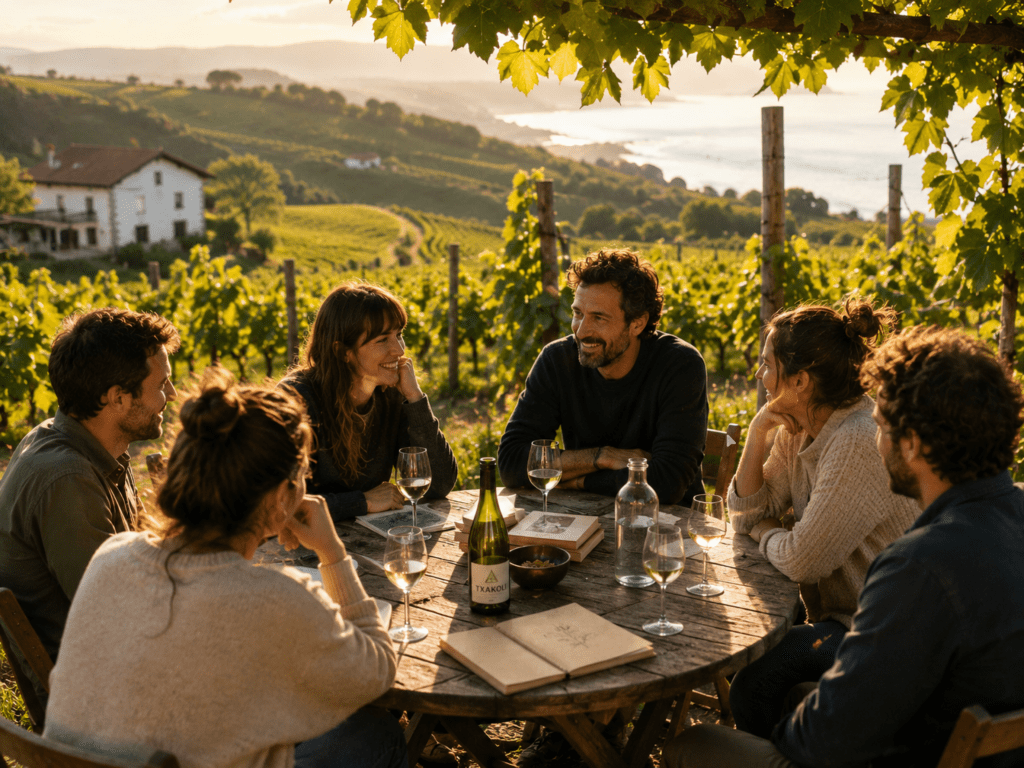
This series was not designed for a crowd. It was designed for a table — a small circle of people in the Basque Country who carry something that is difficult to name but immediately recognizable when you encounter it. A hunger. A disenchantment that has somehow not curdled into cynicism. A sense that the faith they were handed — or the faith they encountered later — was reaching toward something real, but never quite arrived.
If that describes you, you are in exactly the right place.
You are not here because you have answers. You are not here because you have built something impressive or because your spiritual life is particularly ordered or fruitful. You are here because something in you is still looking. Still paying attention. Still unwilling to settle for a version of faith that doesn’t tell the truth about your actual life.
That is not a small thing. In fact, in our experience, it is precisely that kind of person — curious, honest, quietly stubborn in their hope — through whom the Kingdom most naturally begins to move.
This land has a long memory.
Christianity has been part of Basque life for more than a thousand years. Ignatius of Loyola was born within sight of these mountains. The faith is not foreign to this soil. The name of God has been spoken in Euskara across these valleys and coastlines for centuries, carried by people who built their lives around it, who passed it to their children, who shaped their culture in its light.
And yet something has shifted.
Walk through Bilbao, Donostia, or Vitoria-Gasteiz today and you encounter a spiritual landscape that feels more like depleted farmland than flourishing garden. Not hostile, exactly. But hard. Compacted. Resistant to new growth in a way that has less to do with outright rejection and more to do with exhaustion — the exhaustion that comes from centuries of religion that was more cultural than personal, more institutional than relational, more inherited than chosen.
The faith was passed on. But somewhere in the passing, the living encounter at the center of it got lost.
Then came other expressions — imported forms of Christianity that arrived with energy and emotion and the best of intentions, but without roots in this soil. Forms that felt more South American or North American than Basque. More theatrical than incarnate. And so people who were genuinely hungry for something real found themselves caught between a tradition that felt hollow and alternatives that felt foreign.
That is a painful place to inhabit. And it deserves to be named honestly before we go any further.
But here is what we also believe.
The soil is depleted. It is not dead.
There is a difference — and it matters enormously. Dead soil produces nothing. Depleted soil, tended with patience and attentiveness, can be restored to extraordinary fruitfulness. The farmers John and Molly Chester took over a worn-out piece of California farmland — hard clay that wouldn’t even break when you dropped it — and over eight years of patient, biodiverse cultivation, produced over 500,000 pounds of food from more than 200 varieties of fruits and vegetables. They didn’t force the land to produce. They restored the conditions for life. And the land responded.
We believe the same is possible here.
We believe the Spirit of God has been at work in the Basque Country throughout every season — including the seasons of institutional decline, including the disenchantment, including the long in-between where many of you have been living. We believe the hunger you carry is not a sign that faith has failed. It may be the most important thing about you — the very thing that makes you useful to what God wants to do in this place.
“For I know the plans I have for you,” he told them. “Plans to prosper you and not to harm you, plans to give you hope and a future.”
Exile is not the end of the story. It is often where the most important part begins.
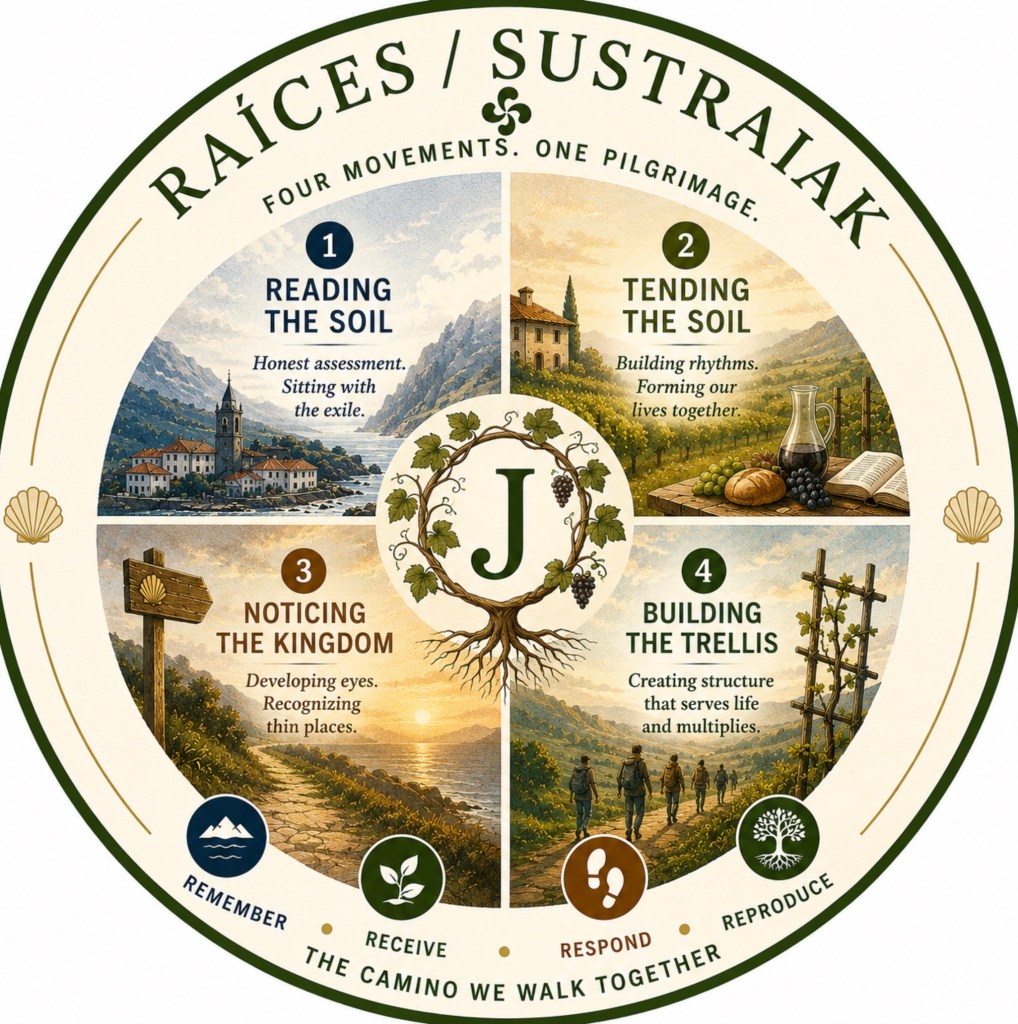
This series moves through four movements.
First we will read the soil together — looking honestly at what has depleted spiritual life in this culture and in our own histories. Not to assign blame, but to see clearly. You cannot tend what you haven’t honestly assessed.
Then we will tend the soil together — exploring what a shared Rule of Life might look like for this community. A simple set of rhythms built around three Basque-resonant anchors: Mahaia, the table; Hitza, the word; Bidea, the way. Not a law to perform but a shared texture of life — something humble enough to actually live, and deep enough to slowly form us into people from whom something real can grow.
Then we will learn to notice together — paying attention to where the Kingdom is already stirring in our existing relationships, and learning to recognize the people through whom it is most visibly moving. We will call these people Kingdom Catalysts. They are not necessarily the most gifted or experienced. They are people with what one practitioner beautifully calls holy imagination — people who can look through the keyhole of the present moment and glimpse the Kingdom possibilities on the other side. They are almost certainly already present in the relationships of everyone in this room.
And finally we will think together about structure — about what the lightest possible trellis looks like for a community beginning to grow. Not to centralize or control or replicate the very thing we’re trying to move beyond. But to support what the Spirit is already doing, the way a trellis supports a vine — from underneath, invisibly, just enough.
One more thing before we begin.
Every session of this series happens around a shared meal. That is not incidental. In the Basque Country, the table is where real life happens. The kuadrilla gathers around food. Friendship deepens over txakoli and pintxos and unhurried conversation. To do this series around a table is to say, before a word is spoken, that what is being formed here belongs to this culture. It is not imported. It is not a foreign transplant. It is the Gospel taking root in Basque soil — slowly, humbly, in the way that things that last always grow.
Nobody needs to arrive with answers. Nobody needs to perform spiritual maturity they don’t feel. The only requirement is the thing you already have — the hunger, the honesty, the willingness to keep looking.
Movements rarely begin with grand strategies. More often they begin with ordinary people learning to notice where the Kingdom is already at work, and responding with simple faithfulness.
That is all we are doing here.
— — —
Let’s begin where every gardener has to begin.
With the soil.
And with the honest question of what it needs.
READ Overview of the Four Movements
Raíces / Sustraiak/ Roots begins with Session One: The Depleted Land.