
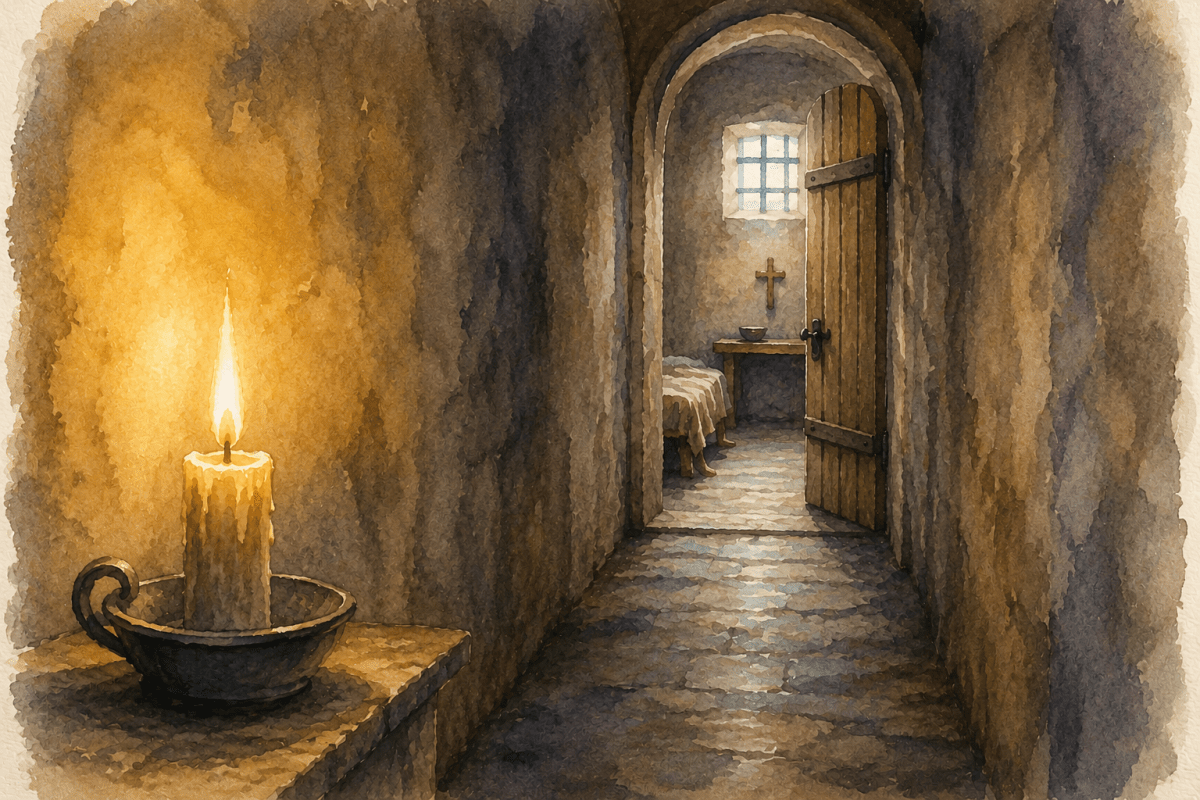
The Candle, the Corridor, and the Cell: A Conversation Worth Having
The following is the kind of conversation that doesn’t happen enough — unhurried, circling back, willing to sit with a question before reaching for an answer. It is offered here as an invitation to that kind of talk.
“Do you ever feel like you’re always just arriving somewhere?”
The question came mid-coffee, the kind of observation that sounds casual but has clearly been waiting.
“What do you mean?”
“I mean — I’m never quite in the place I’m in. I’m thinking about the next thing, or still processing the last thing. Even when I sit down to pray, half my mind is somewhere else. I’m there in body but not really… occupied.”
Occupied. That word is worth pausing on. It has two meanings in English that rarely get held together. To be occupied is to be busy, taken up with something — the opposite of empty. But to occupy a place is also to inhabit it, to be genuinely in it. A house can be occupied and still feel empty. A person can be occupied and still feel absent.
The monastic writers knew this. They had a word for the failure to be genuinely occupied: acedia. We translate it sloth, but that’s too simple. It’s closer to a restlessness that masquerades as calm — the body in the chair, the mind already somewhere else. The noonday demon, Evagrius called it. It visits at the hour when the sun is highest and the day feels longest and the cell feels most like a trap.
“I think that’s just modern life,” someone might say.
And they wouldn’t be wrong, exactly. But the Desert Fathers weren’t writing about modern life. They were writing about the fourth century. Which suggests the problem isn’t primarily modern. It’s human.
The candle on the table
Think about what a candle does in a room.
It doesn’t illuminate everything equally. It creates a centre — a place where light is concentrated, around which the rest of the room organises itself into varying depths of shadow and warmth. To sit near a candle is to be located. The candle says: here. This is here. You are here.
The contemplative tradition has always used light this way. Not floodlight — the blaze that eliminates shadow and makes everything equally visible — but the single flame that creates a centre of attention and asks you to gather around it.
John Cassian writes about the need to hold the mind to a single point — a verse of Scripture, a word of prayer — the way a flame holds to a wick. Not because other things are unimportant, but because attention is always local. You cannot be genuinely attentive to everything at once. The candle teaches you that to be somewhere is always to be here, not everywhere.
What strikes modern readers of Cassian is how psychologically acute this is. He understood, fifteen centuries before neuroscience confirmed it, that the mind does not multitask — it task-switches, rapidly, at the cost of depth. The scattered attention, the half-presence we all recognise in ourselves, is not a feature of life. It is a failure mode. And the cure is not to try harder to concentrate. It is to practice returning — gently, repeatedly, without self-condemnation — to the single point of light.
“That’s what I want,” the person at the coffee table says. “I want to be able to actually be somewhere.”
Yes. That’s the right want. The question is what it takes to get there.
The corridor we keep abolishing
Here is something worth noticing: we have systematically eliminated every corridor from our lives.
Not the physical ones. But the transitional spaces — the brief passages between one thing and another — that used to give life its rhythm and punctuation. The commute that used to be thought; now it’s a podcast. The walk between the car and the front door; now it’s the last thirty seconds of a voice note. The space between waking and beginning; now it’s the phone, face-down on the nightstand, picked up before the eyes are properly open.
These spaces were never empty. They were corridors — liminal, transitional, in-between. And the monastic tradition treated them as spiritual occasions rather than inconveniences to be filled.
Bernard of Clairvaux wrote about consideratio — a kind of disciplined gathering of the self — as the practice of the man who has learned not to arrive somewhere in his mind before his body gets there. The corridor is where recollection happens. You are moving from one thing to another, and the movement itself can be an act of attention: I am leaving this behind. I am moving toward that. I am here, in between, neither.
John of the Cross goes further. The corridor, for him, is not just transitional space — it is the place where the deepest formation occurs. The nada — the dark passage, the in-between — is not an interruption of the spiritual journey. It is its architecture. You cannot get from one room to another without passing through the corridor. And God, it turns out, tends to do his quietest work there.
We have filled all our corridors with noise.
Not because we are lazy or undisciplined — but because the corridor is uncomfortable. It is the place where we meet ourselves without distraction. And most of us have enough unprocessed interior life that meeting ourselves without distraction is genuinely unsettling.
So we reach for the phone.
The invitation isn’t to feel guilty about this. It’s to notice it. To begin, perhaps, to let one corridor a day remain a corridor.
The room that teaches you
Of the three — the candle, the corridor, the cell — the cell is the most demanding.
Abba Poemen said it simply: “Stay in your cell and your cell will teach you everything.” This is probably the most-quoted line from the Desert Fathers and the least understood. We read it as advice about solitude. But Poemen is talking about something harder than solitude. He is talking about staying.
The cell teaches you everything because it is the one place where you cannot escape yourself. The Desert Fathers understood that our restlessness is not primarily caused by external circumstances. The person who cannot be at peace in a quiet room will not be at peace in a beautiful landscape, a loving relationship, or a satisfying career. We bring ourselves with us everywhere we go. The cell simply makes this visible.
Thomas Merton translates this with characteristic directness. The reason solitude is so difficult, he says, is not that we are alone. It is that when we are alone we discover that we have been alone all along — that the busy, relational, always-arriving version of ourselves was in some ways a performance, and the cell is where the performance has to stop.
This sounds bleak. It isn’t. Or rather, it is bleak the way surgery is bleak — necessary, oriented toward healing, not the same thing as despair.
Because what the room teaches you, if you stay long enough, is not only what you are but whose you are. The tradition is unanimous on this: the cell is not a place of self-examination for its own sake. It is the place where, having run out of distractions, you discover that you are not alone in it. The candle burns. The corridor has been walked. You are in the room. And the room is not empty.
But the cell is not the destination
And here is what is easy to miss — what the tradition itself would be the first to name, if we stopped reading too soon.
The cell is not the final destination. It is the school.
Abba Moses — one of the most revered of the Desert Fathers — gave exactly Poemen’s counsel about staying in the cell. But Moses himself was famous for something else entirely: hospitality so extravagant that he would break his own fast to welcome a visitor, would interrupt his solitude without resentment, and would say plainly that love of neighbour and love of God could not finally be separated. The cell was where you were formed. The table was where the formation was for.
This is the movement the tradition insists on and that we most easily lose. We read the desert literature and hear an invitation to a perfected interiority — a self so recollected, so attentive, so at peace in the room that it no longer needs anything outside it. But that is precisely what the tradition does not say. Solitude is not the point. Communion is.
Benedict understood this architecturally. The monastery is not a collection of cells. It is a community with cells in it. The cell is one room in a larger house, and the larger house is ordered around shared practices: the common table, the communal Office, the chapter meeting where faults are named and forgiven, the abbot whose role is to hold the community together in love. The cell is where you go to recover yourself. The refectory — the table — is where you discover what you have recovered, and who it is for.
This means that the candle, the corridor, and the cell are not the whole grammar. They are the preparatory grammar — the practices that make genuine community possible. And in the tradition, that community shapes those practices in return.
The candle of attention is tended together in the Divine Office — the community gathering to pray not because each individual has spontaneously decided to do so, but because the community is constituted by this shared rhythm. Your attention is held partly because others are holding theirs alongside you. You are not relying on personal willpower alone. You are being carried by a structure larger than your mood on any given morning.
The corridor is walked together — in procession, in the measured movement between chapel and cloister that the whole community makes in common. When the bell rings, everyone hears it. The corridor is not a private spiritual exercise inserted into an otherwise frenetic schedule. It is a communal threshold that everyone crosses at the same moment.
And the cell, for all its solitude, is held within a web of mutual accountability. The monk is not alone in his cell the way a modern person is alone in a room. He has a confessor. He has an abbot. He has brothers who will notice if he does not appear at prayer, who will knock on the door if he is absent too long, who are invested — as a community — in his formation. The solitude is real. But it is held solitude, supervised by relationships of care and correction.
Dietrich Bonhoeffer, writing from the very different context of an underground seminary in Life Together, says something the desert tradition would entirely recognise: “Let him who cannot be alone beware of community. Let him who is not in community beware of being alone.” The two are not alternatives. They are mutual corrections. The person who has never learned to be alone brings a cluttered, performance-anxious self to every table. The person who has never learned to be at table brings a brittle, unaccountable self back to the cell.
Neither solitude nor community is healthy without the other.
Which means the deepest question these practices raise is not personal. It is communal. Not only: how do I tend the candle, walk the corridor, stay in the cell? But: who is doing this with me? Who knows? Who will notice? Who will knock?
The table is what the cell is for. And it turns out the table cannot be set alone.
An invitation
These are not ideas meant to be held at arm’s length as intellectual objects to admire or critique. They are practices — or rather, they are the beginning of a vocabulary for practices that most of us sense we need but don’t quite have the words for.
We’d like to continue this conversation over coffee — slowly, unhurriedly, in the spirit of the thing itself. No agenda. No presentation. Just a table, a drink, and enough time to actually arrive somewhere together.
If that sounds like something you’d want, come.
And if you want to come with something to think about beforehand, here are a few questions worth sitting with — not just privately, but in the light of what the tradition is pressing us toward together:
Questions for the table
On the candle: Where does your attention actually live most of the time? Not where you wish it lived — where does it actually go when nothing is demanding it? And is there anyone in your life who knows the honest answer to that question alongside you?
On the corridor: Which transitions in your day have you filled with noise or stimulation? What would it feel like to leave one of them empty this week — not as a spiritual exercise, but just to see what’s there? And who might you walk through that experiment with, even informally?
On the cell: Is there a place — physical or temporal — where you regularly meet yourself without distraction? If not, what would it take to make one? And what community, if any, is helping to make that possible — or might?
On the table: The tradition assumes these practices require community — that you cannot tend the candle alone indefinitely, that the corridor needs people on either side of it, that the cell is most formative when you are accountable to others who are also staying. Is there a table you return to regularly — not just coffee once in a while, but something more committed, more covenantal — where the same faces gather, where people know where your attention actually lives, where someone would notice if you stopped showing up?
If not — what would it take to find one? Or to build one?
And the question underneath all the others: We tend to treat spiritual practice as personal and community as the thing we add afterward, if we have energy left. What would it look like to invert that — to let the community be the primary thing, and the personal practices exist to make you more genuinely present to it?
Bring your best question. Or just bring yourself. Either is enough. The table has room.