
An Invitation to Outside Missionaries and Organizations to Consider Something Different
We need to have an honest conversation before we issue an invitation.
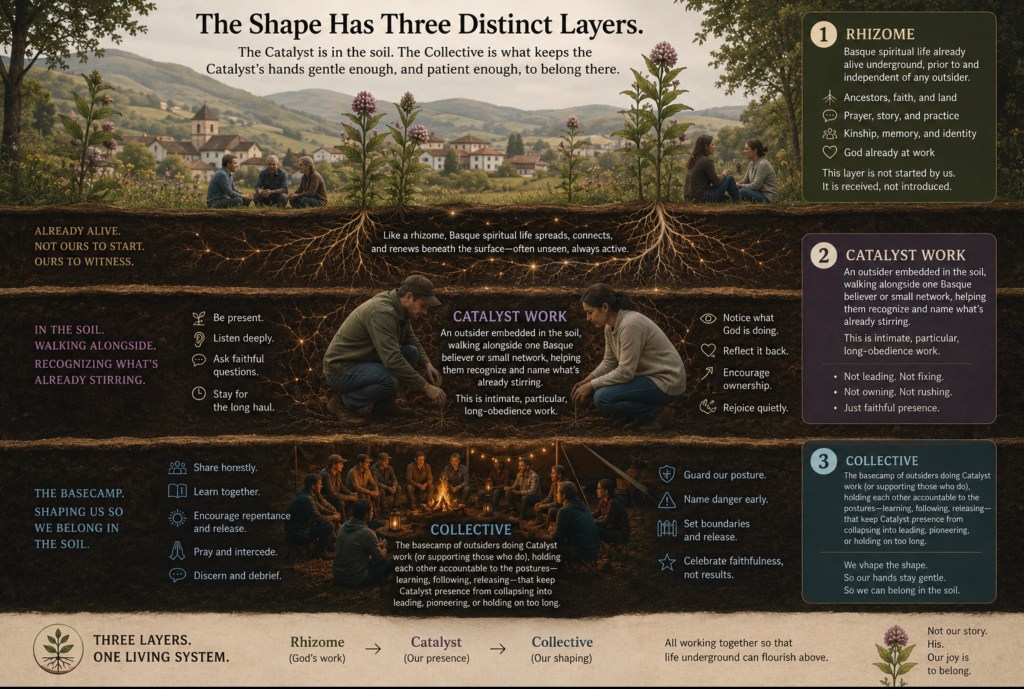
The conversation is this: outside missionary presence in the Basque Country has not, historically, served the Basque church well.
Not because the people who came were bad people or because the organizations that sent them had wrong intentions. But because the models they brought — however effective in other contexts — were not designed for this soil. And soil that has already been depleted by one form of monoculture does not recover by introducing another one.
If you are a missionary organization with work in the Basque Country, or an individual practitioner who has given years to this place, we are not writing to criticize what you have done. We are writing because we believe something genuinely new is possible — and because that new thing requires outside practitioners and organizations to operate in a genuinely different way than most of us have been trained to operate.
This is an invitation to consider that different way together.
Something Is Stirring
There is a small community of believers in the Basque Country gathering around a table.
They are not a church in the conventional sense. They have no building, no Sunday service, no pastor, no program. What they have is a shared hunger — the hunger of people who were formed by a Catholic tradition that gave them real gifts and real wounds, who encountered other expressions of Christianity that felt imported and thin, and who found themselves in the in-between. Not faithless. Not finished. But unable to find a form of faith adequate to the depth of their actual experience.
Around that table, something is beginning to grow.
Shared rhythms of life together. A developing capacity to notice where the Kingdom is already stirring in their existing relationships. The slow, patient formation of people who are becoming — without quite knowing it yet — the kind of disciple-makers and community-formers from whom genuine Gospel movement in the Basque Country might eventually emerge.
It is small. It is early. It is exactly the kind of beginning that gets overlooked by organizations looking for scalable models and measurable outcomes.
And it is, we believe, where everything starts.
What We Have Learned Elsewhere
In Kansas City, a network called the KC Underground has been developing what they call a Collective — a covenant community of practitioners committed to seeing Gospel movement take root in their city. Not a coalition of organizations pursuing parallel agendas. A genuine community of people who have surrendered enough of their organizational identity to pursue a shared vision together.
In Chicago, a similar expression has taken shape — practitioners from different backgrounds and different organizations finding that their effectiveness multiplied when they stopped competing for the same relationships and started genuinely collaborating toward the flourishing of the city rather than the growth of their individual efforts.
Both of these collectives were built around a simple conviction:
that the Kingdom moves most freely when practitioners are more committed to the vine than to their own trellis. When the structure exists to serve the life rather than to sustain itself.
We believe something similar is needed in the Basque Country. And we believe it needs to be shaped by the specific texture of this place — its history, its wounds, its cultural instincts, its extraordinary potential for a genuinely indigenous Gospel movement that looks nothing like what has been imported before.
We are calling it the Basque Collective.
Why the Basque Country Requires Something Different
Before we describe what the Basque Collective is, we need to name what makes this context genuinely distinct — because the specific shape of the Collective emerges directly from the specific realities of the soil it is designed to serve.
The Basque people are not unreached. They are burned.
There is a significant difference between a culture that has never encountered the Gospel and a culture that has encountered a distorted version of it for a thousand years. The Basque Country is not a blank slate. It is a landscape shaped by centuries of Christendom religion — faith as cultural inheritance, institution as mediator, the church as the bearer of Basque identity through political suppression — followed by rapid secularization, followed by imported evangelical expressions that arrived with enthusiasm and left with little lasting root.
The people in the Basque Country who are most resistant to the Gospel are not resistant because they have never heard it. They are resistant because what they have heard has not been adequate to the depth of their actual experience. They have tasted the old wine and found it insufficient — and when new wine arrives in forms that feel like variations of the same old wineskin, they recognize it immediately.
This means that approaches calibrated for unreached peoples — high-visibility presence, rapid church planting, measurable conversion metrics, imported models — will not only fail here. They will make the soil harder. They will confirm the existing suspicion that Christianity is something brought from outside by people who do not understand this place.
The Basque cultural grain is extraordinarily strong.
The Basque people have maintained a distinct language, culture, and identity through centuries of pressure from France and Spain, through the Franco years of brutal suppression, through the violence of the following decades. They have not been absorbed. They have not been assimilated. They have refused, with fierce and admirable consistency, to become something other than Basque.
This is not an obstacle to Gospel movement. It is one of its greatest potential assets. A faith that genuinely takes root in Basque soil — that is expressed in Euskara, that moves through the relational structures of the kuadrilla, that honors the local and the particular over the imported and the generic — will be extraordinarily resilient. It will belong to the people rather than to the organization that planted it. It will multiply through existing networks rather than requiring outside maintenance to survive.
But it means that outside presence must be genuinely subordinate to Basque leadership, Basque culture, and Basque pace in ways that most missionary organizations find structurally difficult to sustain.
The soil is depleted, not dead.
This distinction matters enormously for how outside practitioners approach their work. Dead soil requires the introduction of life from outside. Depleted soil requires the restoration of conditions that allow what is already present to flourish.
The Basque Country has genuine spiritual life already present — in the small communities beginning to gather, in the questions ordinary Basque people are already asking, in the hunger that the disenchantment has produced, in the Basque cultural instincts for community and loyalty and fierce local belonging that are closer to the New Testament picture of church than almost anything produced by Western institutional Christianity.
Outside presence that tries to introduce life where there is none will damage this soil further. Outside presence that learns to see what is already alive and creates the conditions for it to flourish — that is what the Basque context requires.
What the Basque Collective Is
The Basque Collective is a covenant community of outside practitioners — missionaries, organizational representatives, church planters, tentmakers, and anyone else whose vocation has brought them to the Basque Country — who commit together to a shared set of postures and practices designed to serve the flourishing of the Basque church on the Basque church’s own terms.
The Basque Collective …commit together to a shared set of postures and practices designed to serve the flourishing of the Basque church on the Basque church’s own terms.
It is not a coordinating body for outside organizations. It is not a strategy alignment meeting. It is not a network for sharing resources and avoiding duplication — though those things may happen as a byproduct.
It is a community. A genuine one. Built around the same convictions and the same rhythms that the series of conversations called Raíces / Sustraiak has been building among Basque believers.
The Collective organizes itself around three anchors — borrowed from the Basque language, because the Collective exists to serve this place and its language is one of the primary ways it demonstrates that commitment.
Mahaia — The Table
The Collective gathers regularly around a shared meal. Not to strategize. Not to report on organizational metrics. To be genuinely present to one another as people who are carrying something difficult — the long, slow, often invisible work of serving a movement that cannot be rushed, in a culture that does not grant trust quickly, in a context where the visible fruit of faithful presence may not appear for years.
Outside practitioners in resistant cultural contexts are among the most isolated people in ministry. They often cannot be fully honest with their sending organizations about the pace of progress. They cannot be fully honest with the local community about their own uncertainty. They need a table of their own — a community of people who understand the specific texture of their calling and who can provide what Session 6 of Raíces / Sustraiak calls the long obedience support.
The Mahaia of the Collective is also the place where the Collective practices what it is trying to cultivate. If we are going to serve a movement built around genuine community and shared meals, our own life together must embody that. Organizations that preach community while operating transactionally are not credible in any cultural context — and in the Basque context, where authenticity is recognized and valued with particular intensity, the gap between what we preach and how we actually live will be noticed long before anything else we do.
Hitza — The Word
The Collective develops a shared theological imagination — not through doctrinal agreement documents, but through sustained communal engagement with Scripture and with the theological and spiritual tradition of the Basque Country itself.
This means the Collective reads the Basque theologians. It engages the history of the faith in Euskal Herria. It learns what the Spirit has been doing in this land before any of its members arrived. Ignatius of Loyola was born forty kilometers from Donostia. The spiritual tradition of this land is not thin. It is deep and rich and largely ignored by outside practitioners who arrive with their own theological frameworks already fully formed.
The Hitza of the Collective also includes a shared practice of honest self-examination. The Collective regularly asks — in the light of Scripture and in the light of Basque history — whether its presence is actually serving the flourishing of the Basque church or subtly undermining it. This is not false modesty or performative self-criticism. It is the kind of prophetic self-scrutiny that every outside presence in a post-Christendom missional context must practice as a regular discipline if it is to remain genuinely useful rather than gradually becoming one more form of outside imposition.
Bidea — The Way
The Collective commits to a shared Way — a set of specific postures that govern how its members relate to the Basque community they serve.
Learning before leading. Every member of the Collective commits to a sustained period of genuine presence and learning before any form of ministry initiative is attempted. Not orientation. Not language study with evangelistic intent. Genuine, unhurried, curious presence — learning the culture, the history, the language, the relational networks, the specific spiritual landscape of the community they are embedded in. This period should probably be longer than feels comfortable. The Basque culture does not grant trust quickly. It grants trust to people who demonstrate, through sustained presence over time, that they are not leaving when things get difficult.
Following before pioneering. Every member of the Collective commits to following the lead of the Basque believers they are in relationship with rather than pioneering their own initiatives. When a Kingdom Catalyst emerges — a Basque person in whose existing relationships the Kingdom is visibly stirring — the outside practitioner’s role is to support and resource that emergence, not to redirect it toward their organization’s preferred model or to insert themselves into a leadership position within it.
Releasing before it feels ready. Every member of the Collective commits to releasing what they have helped develop before it feels ready — before they feel certain that the Basque leaders are sufficiently formed, before the community has achieved the scale originally envisioned, before the organization has built sufficient evidence of fruit to satisfy its supporters. The trellis exists to support the vine until the vine is strong enough to grow without it. Knowing when to release is as important as knowing when to hold.
What the Collective Is Not
This needs to be said plainly because the history of missionary collaboration is full of collectives that became what they were designed to prevent.
The Basque Collective is not a coordinating umbrella for outside organizations to manage their respective turf in the Basque Country. If your organization is primarily interested in ensuring that your presence and influence in the Basque Country is protected and enhanced, the Collective is not the right community for you.
The Basque Collective is not a church planting network oriented toward measurable church multiplication targets. The metaphors that govern the Collective’s imagination are soil, vine, trellis — not pipeline, funnel, or launch. The pace is seasonal, not quarterly.
The Basque Collective is not a community where outside practitioners hold the authority. The Collective’s primary accountability is to the Basque believers it serves — not to sending organizations, not to donors, not to the Collective’s own leadership. Basque believers should have genuine authority over the Collective’s presence, activities, and continued involvement in the Basque context. That is not a nice-sounding principle. It is a structural requirement.
The Basque Collective is not for everyone who wants to serve in the Basque Country. It is for practitioners who have genuinely reckoned with the history of outside presence in this context and who have arrived at a place of honest humility about what outside presence can and cannot offer. If you are not yet at that place, the most honest thing the Collective can do is invite you toward that reckoning rather than into membership.
What We Are Asking
We are not asking for organizational commitments or funding pledges. We are asking for something simultaneously simpler and more demanding than either of those.
We are asking whether you are willing to come to a table.
- Not a strategy table. Not a partnership table. A meal. An unhurried conversation among people who care about the same place and who are willing to be honest with each other about what outside presence has accomplished and failed to accomplish and what it might yet become if it is structured differently.
- We are asking whether your organization is willing to consider what it would mean to genuinely subordinate its agenda to the flourishing of the Basque church — to measure its success not by the growth of its own programs and presence but by the growing capacity of Basque believers to lead their own movement without ongoing outside support.
- We are asking whether you personally — if you are a practitioner in the Basque Country — are willing to commit to the long, slow, often invisible work that genuine soil restoration requires. To learn Euskara not as a missional tool but as an act of love. To follow before you lead. To release before you feel ready.
If any of that resonates — even partially, even with significant questions attached — we want to hear from you.
The Bigger Vision
What we are ultimately hoping for — because it will help you decide whether this is a community you want to be part of.
We believe the Basque Country is on the edge of something. Not a revival in the conventional sense — not a sudden dramatic movement of large-scale conversion and visible church growth. Something more like what the series Raíces / Sustraiak/ Roots describes — a slow, patient, biodiverse restoration of the spiritual soil of this extraordinary culture. Small communities gathering around tables. Kingdom Catalysts emerging in existing Basque relational networks. A genuinely indigenous expression of Gospel community taking root in Basque soil — expressed in Euskara, shaped by Basque cultural instincts, led by Basque people, sustainable through Basque resources and Basque leadership.
Outside presence, in that vision, plays a specific and limited role. It provides, for a season, the lightweight trellis that supports what is growing until the vine is strong enough to grow without it. And then it releases — genuinely, structurally, without requiring ongoing credit or ongoing control — what it helped to cultivate.
That is a different kind of missionary success than most of our organizations were designed to pursue. It produces a different kind of fruit than most of our donors were expecting when they invested in Basque work. And it requires a different kind of practitioner than most of our sending structures have been designed to form.
But it is the kind of success that the Basque Country actually needs. And we believe there are enough people and organizations that genuinely care about that — more than they care about their own organizational growth or their own missional legacy — to form a community capable of pursuing it together.
A Final Word
We began with an honest conversation. We want to end with one.
The Basque Collective will only be what it claims to be if the people who form it are willing to be ruthlessly honest with themselves and with each other about the gap between their stated commitments and their actual behavior. That gap is always present. In every missionary organization. In every outside practitioner. In every collective that has ever been formed with good intentions.
The question is not whether the gap exists. It is whether the community has the structures, the relationships, and the shared courage to keep naming it and keep closing it — year after year, in the ordinary texture of ordinary work, in a place that will notice the difference between what we say and what we do long before it is willing to trust us with anything that actually matters.
We are not offering a polished model. We are offering an invitation to a table where honest people can ask honest questions together about what genuine outside service to the Basque church actually requires.
The oak doesn’t grow in a day.
But it has to begin somewhere.
If this resonates — reach out. Come to the table. Bring your questions, your organizational tensions, your honest uncertainty about whether what you have been doing is actually serving what you came here to serve.
That honesty is not a disqualification. It is the beginning of something genuinely different.
Grace and grit to you as you consider it.
The Basque Collective is in formation. If you are a missionary practitioner, organizational representative, or sending church with involvement in the Basque Country and you want to explore what this community might become, we would love to hear from you.