
A Discussion Pathway for Basque Believers and the Outsider Catalyst
This pathway is not a curriculum to be delivered. It is a series of conversations to be entered together — at Basque pace, around a real table, with real food, over as many gatherings as the group needs. The facilitator’s role is to hold the space, not to fill it. The oak doesn’t grow in a day.
Before You Begin
This pathway assumes two things that are worth naming before the first conversation:
First, that both parties — Basque believers and the outsider catalyst — come with genuine questions about whether this relationship will serve the Basque community’s flourishing on the Basque community’s own terms. Not answers. Questions. The pathway only works if the outsider is as genuinely uncertain about their role as the Basque believers are about whether to trust it.
Second, that what is being built here is a container, not a program. The Rule of Life that emerges from these conversations is not a set of activities to perform together. It is a set of honest commitments that make the deeper journey — learning to recognize God’s presence already stirring in Basque life — safe enough to undertake together.
A Rule entered into without genuine mutual consent is not a Rule. It is another form of outside imposition. These conversations exist so that the Rule belongs to everyone who signs it.
Gathering One: Who Are We to Each Other?
Purpose: To name the relationship honestly before asking anything of it.
Opening Practice
Share a meal together before anything else is said about the pathway or the Rule. No agenda. No introduction of purpose. Just presence. Let the conversation go where it goes.
After the meal, before clearing the table, the facilitator says something like:
“Before we talk about what we might build together, I want to make space to talk honestly about who we are to each other — and what history sits between people who come from outside and the Basque community they say they want to serve.”
Conversation
For the whole group:
- What words come to mind when you hear “outsider” in the context of faith in the Basque Country? What feelings?
- Has outside religious presence — whether Catholic institution or imported evangelical expression — served this community well, in your experience? Where has it helped? Where has it damaged?
- What would it take for this relationship to be different from those?
Directed to Basque believers:
- What would you need to see from an outsider before you could trust them with something that actually matters to you?
- What is the thing you most fear this relationship could become?
Directed to the outsider catalyst:
- What have you brought here — assumptions, models, hopes, organizational expectations — that you have not yet named out loud?
- What is the thing you most fear you might do here, even with good intentions?
Closing Practice
Before leaving, each person names one thing they heard from someone else at the table that they want to carry with them until the next gathering. Not a response. Not a rebuttal. Just: “I heard you say _______, and I’m going to sit with that.”
Gathering Two: What Does Each of Us Need?
Purpose: To surface what each party requires from the relationship before either party commits to it.
Opening Practice
Begin with a brief silence — two or three minutes — before any conversation. Then invite each person to finish this sentence, without interruption or response from others:
“For me to trust this table with something real, I would need ________.”
Write down what each person says. These become the raw material of the Rule.
Conversation
On pace:
- What rhythm of gathering feels sustainable to you — not ambitious, not obligatory, but genuinely sustainable over years?
- What would it feel like if the pace were set by the outsider’s timeline rather than the Basque community’s? What would it feel like if it were the other way around?
On authority:
- Who should have the power to say “this isn’t working” or “we need to change course”? How would that be said? How would it be heard?
- If a Basque believer told the outsider catalyst that their presence was no longer serving the community, what should happen? How do we make that possible to say?
On honesty:
- What makes it safe — or unsafe — to say difficult things in a group like this?
- What is the thing that is most likely to go unsaid in this relationship, and why?
On the outsider’s organizational ties:
- What does the organization or church that sent you expect from your time here? How might those expectations conflict with what this community needs?
- Can you name that tension out loud, here, as part of what we are working with?
Closing Practice
Return to the list of what each person said they needed. Read it back aloud. Ask: “Is there anything missing? Anything that was said that already feels like a commitment?”
Leave the list on the table. It belongs to everyone.
Gathering Three: What Is Already Alive Here?
Purpose: Before drafting any commitments, to practice together the core act the Rule is meant to protect — noticing God’s presence already stirring in Basque life.
Note: This gathering shifts tone. It is less diagnostic and more contemplative. It is the first act of the Roots exploration itself — the Rule being formed around an experience of what the Rule is for.
Opening Practice
Invite each person to bring one object to this gathering — something small, something that belongs to their ordinary life in the Basque Country. Not a religious object. Something from daily life: a tool, a food, something from work, something from the landscape.
Place the objects in the center of the table.
Begin by asking: “What does this object know about this place that you could not have taught it?”
Conversation
On the soil:
- Where have you sensed something stirring — in your own life, in the lives of people around you — that feels like it belongs to this place rather than having been brought here?
- What Basque words, images, or practices carry something sacred for you, even if you have never named it that way?
- What has the disenchantment — the leaving behind of old forms of faith — made room for, as well as what it has taken away?
On recognition:
- Has there been a moment when you recognized something of God in a place or a person or a practice that you were not expecting to find it? What did that feel like?
- What gets in the way of that kind of recognition — inside yourself, in the relationships around you, in the broader cultural air?
On the outsider’s role in this:
- Outsider catalyst: What have you noticed stirring here that you did not bring? What has surprised you?
- Basque believers: Has the outsider’s presence helped you see something you might have missed, or has it pointed you toward something you already knew? What is the difference between those two experiences?
Closing Practice
Invite a period of silence — longer than feels comfortable. Then ask: “What do you want to protect? What, from what we have touched in this conversation, is fragile enough that we need to be careful with it?”
Write down the answers. These become the heart of what the Rule is guarding.
Gathering Four: Drafting the Commitments
Purpose: To move from conversation to covenant — drafting, together, the actual language of the shared Rule. See example of a Community Rule of life

Opening Practice
Spread out on the table the notes from all three previous gatherings: what each person said they needed, what was named as fragile, what was recognized as already alive. Let the group see the whole of what has been said.
Begin with this question: “What has emerged from these conversations that we actually want to commit to? Not what we think we should commit to — what we genuinely want to hold each other to?”
The Shape of the Rule
A shared Rule of Life for this relationship needs commitments in four areas. The group should draft language for each one together, in their own words, not borrowed from any outside model:
Pace — How will we move? At whose rhythm? Who has the authority to slow things down, and how will they say so?
Draft questions:
- How often do we gather, and what makes that number right rather than convenient?
- What is the equivalent, in this relationship, of “Basque pace” — and how will we know when we are violating it?
- What does it look like to stay in a season rather than rushing to the next one?
Presence — What quality of attention do we owe each other and the community?
Draft questions:
- What does genuine presence look like in this relationship, as opposed to showing up with an agenda?
- What do we commit to before we attempt anything?
- How long does the outsider commit to remaining before any initiative is attempted — and is that long enough to be believable?
Authority — Who leads, and how do we structure that honestly?
Draft questions:
- In plain language: who holds authority over the direction of this relationship?
- How does the outsider submit to Basque leadership in ways that are structural, not just rhetorical?
- What happens when the outsider’s organizational expectations conflict with the community’s actual needs?
Release — How will we know when to let go?
Draft questions:
- What are the signs that the outsider’s role is shifting — that what was needed is no longer needed in the same form?
- How do we name that without it feeling like failure or abandonment?
- What does the outsider commit to releasing, and when?
A Note on Language
If the group chooses to anchor the Rule in Euskara — pace, presence, authority, release expressed in Basque words chosen by the Basque members of the group — that choice itself becomes an act of covenant. The language the Rule is held in shapes who the Rule belongs to.
Closing Practice
Read the draft aloud together. Ask: “Is there anything here that one of us would not actually keep? Say it now rather than after we have committed.”
Revise. Read again. This may take more than one gathering. That is not a delay. That is the Rule doing its work before it is signed.
Gathering Five: Entering the Rule Together
Purpose: To cross the threshold from drafting to covenant — simply, seriously, without ceremony that belongs to a different culture.
The Threshold Question
Before any formal commitment, ask the whole group one final question:
“Is there anything unresolved — any fear, any doubt, any reservation — that should be named before we commit? Not to stop us, but so that the commitment is made with full knowledge of what we are carrying into it.”
Hold space for genuine answers. The Rule that is entered honestly is more durable than the Rule entered smoothly.
The Commitment
Read the Rule aloud together, slowly. Then ask each person to say, in their own words:
“I am committing to this because ________.”
Not a formula. Their own words, their own reasons. Let those be heard and held.
If the group chooses to mark the moment — with a meal, with a shared Basque practice, with silence, with something from the objects on the table from Gathering Three — let that choice come from the Basque members of the group, not the outsider.
The Living Document
The Rule is not finished when it is signed. It is a living document, reviewed together at intervals the group determines — annually, seasonally, whenever something significant shifts. The review question is always the same:
“Are we keeping what we committed to? Where is the gap between what we said and what we are actually doing? What needs to change?”
That honest, regular self-examination is not a failure mode. It is the Rule working as it was designed to work — keeping the relationship honest, keeping the soil from being compacted again by good intentions poorly examined.
A Final Word to the Outsider Catalyst
You will be tempted, somewhere in this pathway, to move things along. To fill a silence. To offer a framework when the conversation stalls. To produce a draft of the Rule because you have done something like this before and you know what a Rule of Life looks like.
Resist that.
The pathway is not slow because it is inefficient. It is slow because the Basque context requires it to be — because trust is built at Basque pace, because the Rule that is produced too quickly belongs to the person who produced it, and because the most important thing you can demonstrate in these five gatherings is that you are actually capable of doing what the Bidea asks of you: learning before leading, following before pioneering, releasing before it feels ready.
These five gatherings are the first test of whether those commitments are real.
The oak doesn’t grow in a day. But it has to begin somewhere. This is the beginning.
This pathway is offered as a starting point, not a fixed structure. The group should feel free to reshape it, extend it, collapse it, or set it aside in favor of something that emerges more naturally from their own conversations. A pathway that belongs to the people walking it will always serve them better than one borrowed from outside.

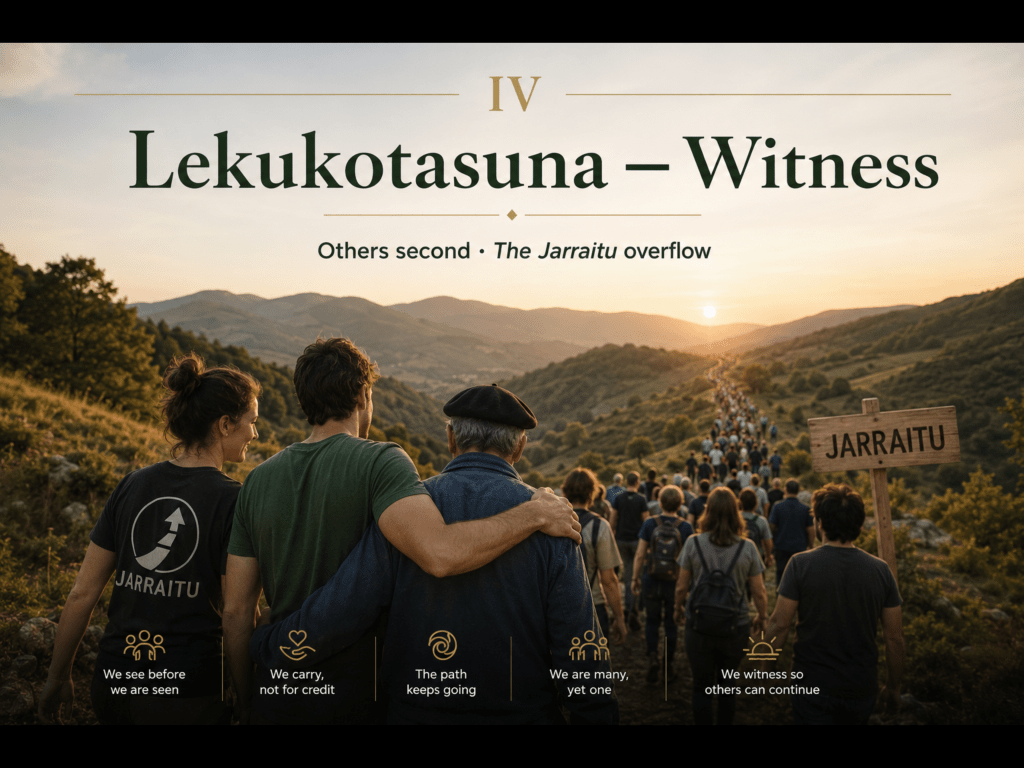
4 PILLARS OF THE CAMINO


5 STAGES OF THE CAMINO TOGETHER
