
The Four Conversions of the Catalyst
Formation for Cross-Cultural Faithfulness in the Basque Country
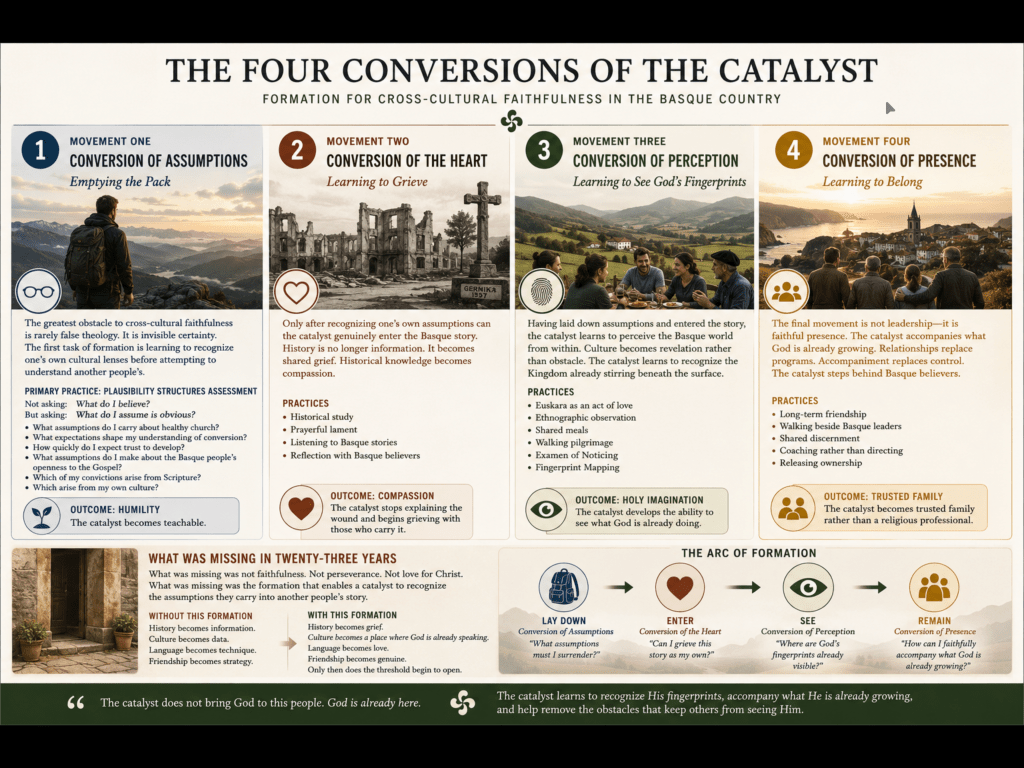
A Brief Overview of The Four Conversions of the Catalyst
Catalyst Formation Series
Becoming the Kind of Person the Basque People Can Trust
Introduction
The first series, Zurekin Egon Da Beti, established the theological framework for Gospel witness in the Basque Country. Drawing from more than thirty years of JOY Ministries’ experience, it argued that God has never been absent from this people. The Spirit has been preparing the soil long before any outside catalyst arrived. The series explored the historical wound, the distinction between the Jesus of the Gospels and the Christ presented through coercive institutions, the communal nature of conversion, and the cultural forms through which the Gospel naturally takes root in Basque life.
This series begins where that one ended.
If God is already at work in the Basque Country, then the central question is no longer “How do we bring the Gospel?”
The question becomes:
What kind of person is capable of recognizing what God is already doing?
Everything that follows grows out of one observation.
A missionary spent twenty-three years in the Basque Country without ever crossing the threshold of a Basque home.
He was faithful.
He persevered.
He loved Christ.
Yet something essential never happened.
The problem was not strategy.
It was not theology.
It was not effort.
It was formation.
The Basque home is opened to a particular kind of presence.
This series explores how that presence is formed.
The Central Claim
Before a catalyst can help cultivate a Gospel movement in the Basque Country, they must themselves be transformed.
Formation is not preparation for mission.
Formation is the first expression of mission.
The catalyst is not first called to change the Basque people.
The catalyst is first called to allow the Basque people—and the Spirit already at work among them—to change the catalyst.
The Four Conversions of the Catalyst
Each movement changes not merely what the catalyst knows but how they perceive reality.
Movement One

Conversion of Assumptions
Emptying the Pack
The greatest obstacle to cross-cultural faithfulness is rarely false theology.
It is invisible certainty. Not knowing what you don’t know.
Every catalyst arrives carrying a plausibility structure—a web of assumptions about church, leadership, evangelism, hospitality, conversion, authority, community, and success.
Most of these assumptions are not biblical.
They are cultural.
Because they feel obvious, they remain unquestioned.
The first task of formation is learning to recognize one’s own cultural lenses before attempting to understand another people’s.
Primary Practice
The Plausibility Structures Assessment
Not asking: What do I believe?
But asking: What do I assume is obvious?
Questions include:
- What assumptions do I carry about healthy church?
- What expectations shape my understanding of conversion?
- How quickly do I expect trust to develop?
- What assumptions do I make about the Basque people’s openness to the Gospel?
- Which of my convictions arise from Scripture?
- Which arise from my own culture?
Outcome
Humility.
The catalyst becomes teachable.
Movement Two
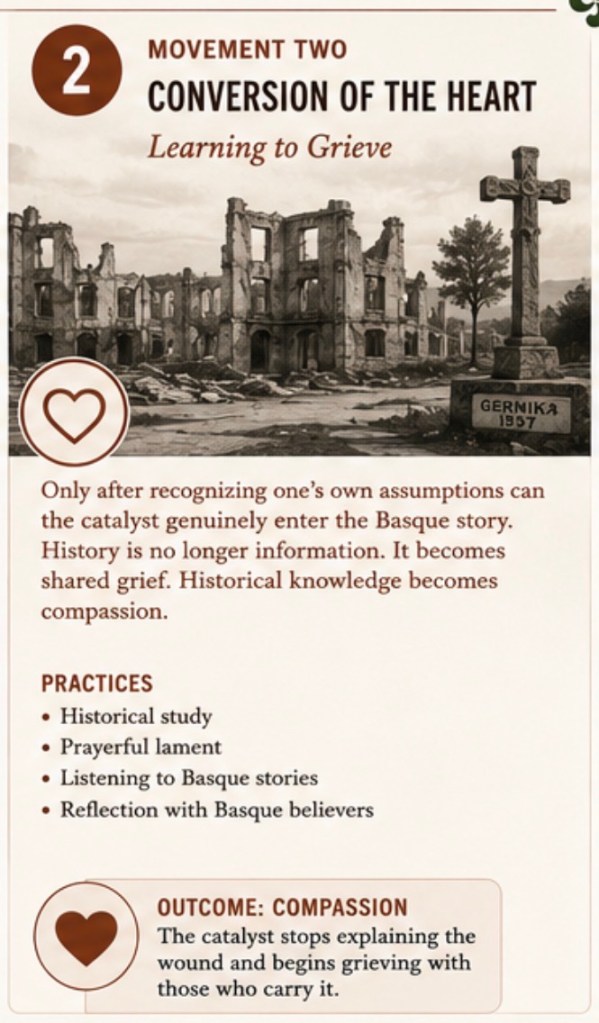
Conversion of the Heart
Learning to Grieve
Only after recognizing one’s own assumptions can the catalyst genuinely enter the Basque story.
History is no longer information.
It becomes shared grief.
The practitioner learns the history of the Zugarramurdi trials, Salazar Frías, Gernika, Euskara, and the moral complexities of the twentieth century—not to win arguments but to carry sorrow.
Historical knowledge becomes compassion.
Primary Practices
- Historical study
- Prayerful lament
- Listening to Basque stories
- Reflection with Basque believers
Outcome
The catalyst stops explaining the wound and begins grieving with those who carry it.
Movement Three

Conversion of Perception
Learning to See God’s Fingerprints
Having laid down assumptions and entered the story, the catalyst now learns to perceive the Basque world from within.
This movement cultivates theological listening.
Ethnography becomes discipleship.
Language becomes love.
Culture becomes revelation rather than obstacle.
The catalyst studies Barandiaran, learns Euskara, attends bertso-saioak, walks neighborhoods, shares meals, and practices the Examen of Noticing.
These are not techniques.
They reshape perception.
The catalyst learns to recognize the Kingdom already stirring beneath the surface.
Primary Practices
- Euskara as an act of love
- Ethnographic observation
- Shared meals
- Walking pilgrimage
- Examen of Noticing
- Fingerprint Mapping
Outcome
The catalyst develops holy imagination.
Movement Four

Conversion of Presence
Learning to Belong
The final movement is not leadership.
It is faithful presence.
The catalyst no longer asks,
“How can I build something?”
Instead,
“How can I faithfully accompany what God is already growing?”
Relationships replace programs.
Friendship replaces projects.
Accompaniment replaces control.
Leadership becomes increasingly invisible.
The catalyst steps behind Basque believers rather than remaining in front of them.
Primary Practices
- Long-term friendship
- Walking beside Basque leaders
- Shared discernment
- Coaching rather than directing
- Releasing ownership
Outcome
The catalyst becomes trusted family rather than a religious professional.
What Was Missing in Twenty-Three Years
What was missing was not faithfulness.
What was missing was not perseverance.
What was missing was not love for Christ.
What was missing was the formation that enables a catalyst to recognize the assumptions they carry into another people’s story.
Without that formation, history becomes information.
Culture becomes data.
Language becomes technique.
Friendship becomes strategy.
With that formation, history becomes grief.
Culture becomes a place where God is already speaking.
Language becomes love.
Friendship becomes genuine.
Only then does the threshold begin to open.
The Arc of Formation
Lay Down
Conversion of Assumptions
“What assumptions must I surrender?”
↓
Enter
Conversion of the Heart
“Can I grieve this story as my own?”
↓
See
Conversion of Perception
“Where are God’s fingerprints already visible?”
↓
Remain
Conversion of Presence
“How can I faithfully accompany what God is already growing?”

This framework preserves the themes from Zurekin Egon Da Beti while making the catalyst’s transformation the central narrative. It also places the Plausibility Structures Assessment at the beginning, where it functions as the gateway through which every subsequent practice is interpreted. Rather than being an additional discipline, it becomes the catalyst’s first act of repentance and humility—the willingness to discover that what has always seemed “obvious” may simply be cultural.